The setup board / Practical guide
Arrange a Welcoming Circle
Before choosing a drum, decide how someone will arrive, find a place and feel comfortable staying. A good arrangement makes those small moments easy.
Leave a visible way in
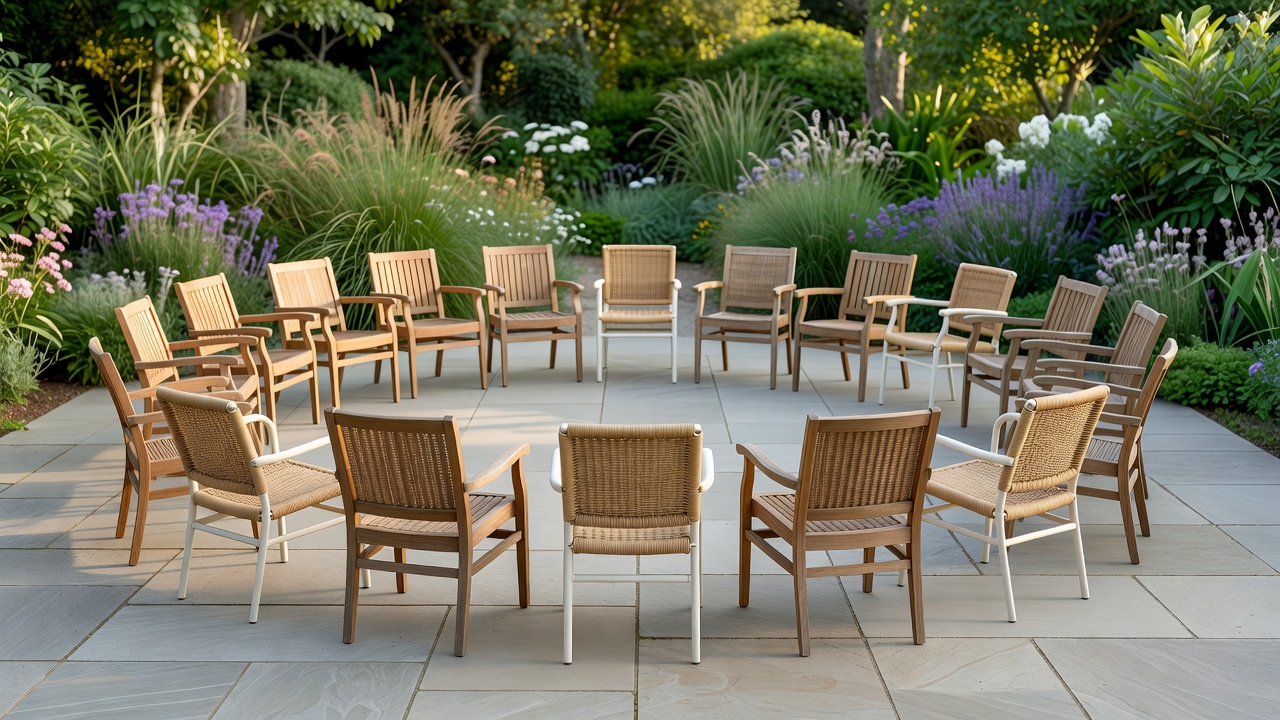
Imagine arriving while everyone else is already seated. A closed ring can feel like a conversation you should not interrupt. Leave a generous entrance facing the route from the gate, and place a spare chair nearby. Ask a welcoming person to notice newcomers rather than leaving that job to whoever is leading a pattern. A simple “Would you like to listen or join?” offers a choice without demanding an explanation.
Keep the route clear of bags, picnic baskets, hosepipes and instrument cases. Check the ground after watering or rain. A route that seemed firm earlier may become slippery or soft. Ask guests about access needs privately and in advance; do not assume that a grass route works for everyone. Provide a firm, level seating option connected to the entrance wherever possible.
Choose seats for people, not a matching photograph
Mismatched chairs are perfectly useful when they are stable. Offer seats with backs as well as any stools, and avoid treating low picnic seating as the only option. Someone may want room for mobility equipment, need to change position or prefer to remain standing. Ask where they would be comfortable instead of moving their equipment or deciding for them.
Arrange the circle so people can see each other without twisting. Leave room for elbows and for safely putting down an instrument. Keep a shaded listening place outside the main ring, but do not make it feel like an exile. Listening, taking breaks and returning later are ordinary ways to participate. Put drinking water somewhere reachable without crossing the playing area.
Start with what you can borrow
A few reliable instruments are more helpful than a crowded equipment pile. Check borrowed drums for loose hardware, sharp edges and unstable stands. Ask the owner how the drum should be supported and played. Bongos, congas and djembes have different playing positions; do not assume every hand drum belongs between the knees. Avoid balancing a heavy instrument on an unsuitable chair.
Equipment choices at a glance
| Option | Useful for | Check first |
|---|---|---|
| Hand drum | Shared pulses and short echoes | Comfortable reach and secure support |
| Closed shaker | Light, simple participation | Intact casing and suitable grip |
| Body percussion | Joining without equipment | Personal comfort; no touching others |
| Listening seat | Resting and enjoying the circle | Shade, sightline and easy access |
Keep small loose objects away from young children and avoid improvised containers that can split or spill. Do not expect guests to use sticks on a hand drum unless its owner approves. A soft surface under a stand may protect paving, but anything added underneath must not make the instrument wobble. Never block a drainage route or an exit to make the arrangement look tidier.
Let the garden set the sound level
Outdoor sound does not stop at the fence. Walls, patios and narrow gaps can send it in surprising directions. Begin with gentle playing, then ask a willing helper to listen from an appropriate boundary location. They should stay on land they have permission to use. If the sound is intrusive, reduce the playing intensity or stop; moving a chair alone is not a reliable solution.
Agree on an obvious stop signal before the first pattern. Explain that anyone can request a quieter moment. Leave amplification out of a small first gathering, and check local noise rules rather than assuming daytime playing is always permitted. The National Institute on Deafness and Other Communication Disorders explains that sound exposure depends on loudness, duration and repetition. Comfortable conversation is a useful social check, not a certified hearing-safety test.
Make packing away part of the setup
Keep covers and a clear storage spot ready before instruments come outside. Protect drums from rain and direct heat according to their makers’ instructions. If thunder is heard, stop and seek appropriate enclosed shelter; a garden canopy is not lightning protection. The National Weather Service provides practical lightning guidance.
Finally, walk the entrance route again before guests arrive. Sit in the least convenient chair, check the shade, and imagine leaving early. If that experience feels awkward, adjust it now. A welcoming circle is not a perfect diagram. It is a space that can change when the next person comes through the gate.